contents of kee’s book
filed in announcement, general, personal | on Sep.10, 2008
Warning: file_get_contents(http://api.bitly.com/v3/shorten?login=tursiainfo&apiKey=R_fe7284ee32bc962288b562dc8aaf9c85&longUrl=http://lucialai.org/2008/09/10/contents-of-kees-book/&format=txt) [function.file-get-contents]: failed to open stream: HTTP request failed! HTTP/1.1 403 Forbidden in /home/lucialai/public_html/wp-content/plugins/share-it/share-it.php on line 53
remember 2 days ago i blog about kee thuan chye’s latest book, ‘march 8: the day malaysia woke up‘, in which i had a part in it? well yesterday i received the complimentary copy from kee himself, with his autograph of course (thanks mr kee!). i flipped through the book and wow!… looking at the contents, i was mighty impressed! there’s so much good reading there. i’m going to start reading the book tomorrow and daily while going to work (in the car, my sister driving lah, so i’m free to read).
to let you in, what the book contain, i had taken the liberty to scan the contents pages and let you have a peep at what you’ll expect to read in the book. you’ll notice interesting titles with well-known names (contributors) like kua kis soong, anil netto, azmi sharom.

ahh… below, here you see my contribution entitled ‘the mother of all ceramahs’
you notice helen ang’s name here twice (and another time towards the end). well, i have helen ang to thank for getting me to contribute to the book. she was the one who informed kee (who btw is her cousin) that i can write something about the ceramah since i was there personally. thanks, helen.
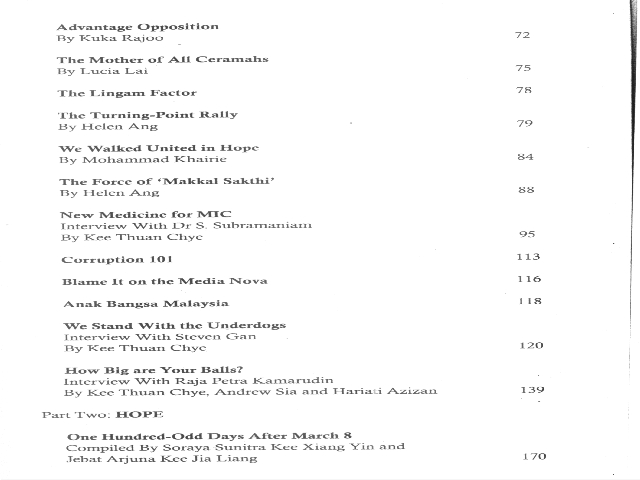
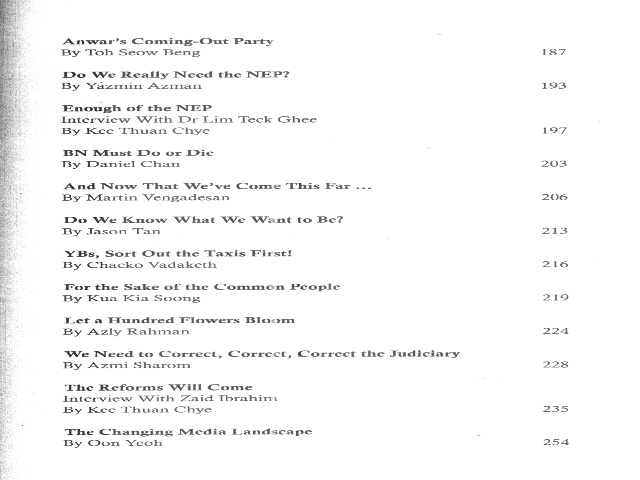
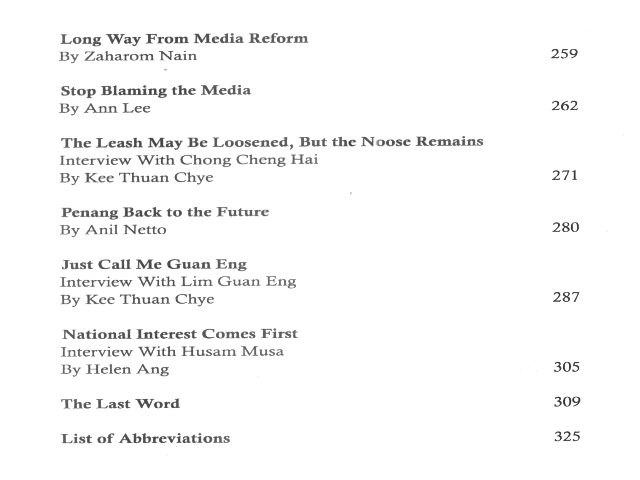
interesting eh? go and grab this book at once! you won’t regret i bet you!
oh just found out, there’s a mention of this book in malaysiakini after i posted this. i am going to CnP the whole article from malaysiakini here:
————————————————
Malaysiakini
March 8: The day Malaysia woke up
Praba Ganesan
Sept 10, 08 6.46pm
Prominent writer, journalist and playwright Kee Thuan Chye, who authored the book ‘March 8: The day Malaysia woke up’, said he would not bet his money on whether there would be a change in government on Sept 16.
He said while some confidantes have told him that this is 99 percent likely to happen, others believe that it will not.
“I would prefer them to show that they can govern and wait for their chance at the next polls,” he told Malaysiakini before the launch of his book in Kuala Lumpur.
However, he stressed that he was not entirely opposed to a new government being formed before the next general elections.
The collection of interviews and contributions from various socio-political observers was compiled following the historic election results on March 8, when five states went to the Pakatan Rakyat coalition.
Kee said the political climate has changed for the better since the general election.
An immediately noticeable difference was the “evaporation” of fear in the collective consciousness of the public to any adverse results following the string of shock defeats of long-incumbent Barisan Nasional candidates.
Despite the shadow of the racial riots of May 13, 1969, Kee said the psychological fear of a repeat of the violence has “dissipated”.
On the current situation, Kee said that Ahmad Ismail – the Bukit Bendera Umno division leader who has stirred up a storm by saying that Chinese Malaysians are squatters in the country – should be charged within the full extent of the law, including the Sedition Act.
Former journalist and TV producer Anwardi Jamil – a contributor to the book – said Umno is “feeling persecuted since it is missing real leadership.”
“Umno is reaching rock-bottom. They are living in denial,” added Anwardi at the event.
A nation awakened
Christine Chong, deputy head of publisher Marshall Cavendish, said the book is available in all major bookstores and likely to be distributed across Southeast Asia and India. About 4,000 copies have been sold since its release last week.
“The book records a turning point in the history of the country,” Chong added.
It looks at developments leading to the general election and then at the election itself.
Bersih and Hindraf received key mention, while there are also election analyses and reactions.
“The second half of the book is about hope – about what will happen and how people feel about the future,” Kee said.
He also said he does not have partisan views about any political party, even though some of his own feelings about the country may have emanated in the book.
Saying he did not expect such an electoral change to occur in his lifetime, he added that it is important the people are more active in exercising their rights and participating in civil society issues.


September 11th, 2008 on 11:09 pm
Would love to get my hands on a copy. I guess the fact that books like Kee’s are being published shows that the Govt. is getting more open.
September 12th, 2008 on 2:01 am
adam
you can order the book via amazon. i’m sure soon it will be at amazon. well i see the book up at the ‘silverfish’ book website but not sure it there, it is up for order. or another way, i can help to buy and post the book for you.
September 29th, 2008 on 3:25 am
Hi,
I just bought the book on friday when I met him (Mr.Kee) on saturday. It was a surprise for me to meet him personally and have a short conversation on his new book.
About the book, is really a good book. I also told him that the MIC part is a bit of potong steam. I’m actually searching for ways to keep in touch with him that I come across your blog.
On your part in his book, its pretty interesting to know how penangite felt at that moment. The mother of all ceramah… well, youtube helps a lot for me to catch up over there. But your writing bring me closer to the atmosphere… Jeff ooi songs still linger in my mind…haha…i kept a video of it. Watch it occasionally
hope to check on your blog more often 
Btw, Does mr.kee have Facebook? haha…anyway, take care.
October 5th, 2008 on 4:00 pm
It’s one thing to wake up
Then you must next sit up
Now you must bravely stand up
To reach beyond your breakfast cup
(C) Samuel Goh Kim Eng – 051008
http://MotivationInMotion.blogspot.com
Sun. 5th Oct. 2008.
January 11th, 2011 on 12:39 am
i had featured the review from malaysiakini here and the earlier post, the review by the star. i just realised that i did not include the review by the nut graph. oh how could i! how could i missed it out when in the nut graph, the review mentioned my article as ‘one of the interesting one’. ok lah. i will now CnP the review from the nut graph here.
=========================
REVIEW BY THE NUT-GRAPH
Don’t let darkness prevail
8 Oct 08 : 9.00AM
By N Shashi Kala
shashikala@thenutgraph.comshashikala at thenutgraph dot com
Updated on 9 Oct 2008 at 6.40pm
IN September, I attended the launch of Kee Thuan Chye’s book March 8: The Day Malaysia Woke Up at Times bookstore in Pavilion Kuala Lumpur.
This engaging slice of Malaysian history chronicles a momentous general election that, some think, heralds the emergence of a two-party system in a political arena long dominated by the Barisan Nasional.
In the book, Kee attempts to distil the impact and possible ramifications of the March 2008 general election. The seasoned journalist interviews prominent personalities — including the irrepressible blogger Raja Petra Kamarudin, who is now under Internal Security Act (ISA) detention — towards achieving this end.
He also relies on essay contributions from a cross-section of Malaysians, including political analysts, bloggers, writers and academicians.
Kee wanted to capture the voices and thoughts of Malaysians who, after 8 March, woke up to a new political dawn, one where there was renewed hope for democracy. To a large extent, March 8 succeeds in doing just that.
Hope flowers
What really struck me about the book was its hopeful tone. Within the book’s chapters was a Malaysia free from the memory of 13 May that has weighed heavy on our collective consciousness like the smell of belacan that won’t go away. It seemed that 8 March banished this terrifying spectre — hopefully (there’s that word again) for good.
Some of the more interesting articles include A Tale of Two Malaysias by Wong Chin Huat and Oon Yeoh; Malay Identity? Yeah, Right by Anwardi Jamil; The Mother of All Ceramahs by Lucia Lai on the DAP ceramah on 6 March 2008 at Han Chiang High School in Penang; and We Walked United in Hope by Mohammad Khairie about the 10 Nov 2007 Bersih rally.
I found the interviews especially enlightening. The encounter between Kee and Minister for Human Resources Datuk Dr S Subramaniam, apparently an old friend, had me grinning from ear to ear. I could almost see the minister squirming as he tried to sidestep issues related to the MIC’s poor electoral showing.
The other interviewees included Penang Chief Minister Lim Guan Eng; PAS vice-president Datuk Husam Musa; former Tenaga Nasional Bhd executive chairperson Tan Sri Ani Arope; former Minister in the Prime Minister’s Department Datuk Zaid Ibrahim; academic Dr Lim Teck Ghee; Malaysiakini founder Steven Gan; and theSun acting editor-in-chief Chong Cheng Hai.
Lost in transition
March 8: The Day Malaysia Woke Up, published by Marshall Cavendish and retailing for RM39.90, belongs to a genre of Malaysian political publications that looks positively to the future. Compared with political books released in 2007 and even in early 2008, it is apparent the mood and tone are worlds apart.
Take for instance, Ooi Kee Beng’s Lost in Transition: Malaysia under Abdullah, about Malaysian politics and regional trends. Published by the Strategic Information and Research Development Centre (SIRD) and the Institute of Southeast Asian Studies, the RM30 book is a collection of commentaries by the political analyst and academician that appeared in various publications from early 2006 to late 2007.
It’s a damning critique of Datuk Seri Abdullah Ahmad Badawi’s leadership — or, as the book posits, lack thereof — and fleshes out the writer’s concerns and outlook for the future in the run-up to the 12th general election.
Ooi looks at the hope Abdullah’s administration first sparked when he took office, and the gradual realisation that the iron will needed to make real the pledges of reform was sadly missing.
The book also looks at Malaysia’s tearing social fabric and deteriorating race relations just as the country was celebrating its 50th merdeka in 2007. All in all, a bleak picture.